Origin and history
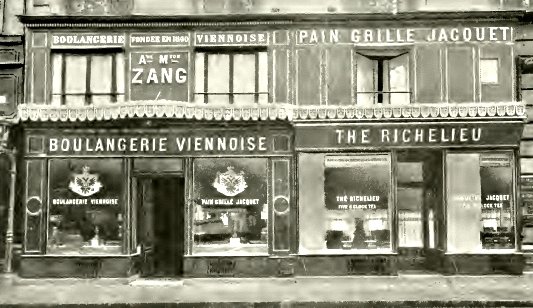
Back to main pageThe kipferl, an Austrian crescent-shaped pastry, can be dated back to at least the 13th century in Austria, and came in various shapes. The kipferl can be made plain or with nuts or other fillings (some consider the rugelach a form of kipferl). The original Boulangerie Viennoise in 1909 (when it was owned by Philibert Jacquet). The bakery proper is at left and its tea salon at right. In either 1838 or 1839, an Austrian artillery officer, August Zang, founded a Viennese bakery ("Boulangerie Viennoise") at 92, rue de Richelieu in Paris.
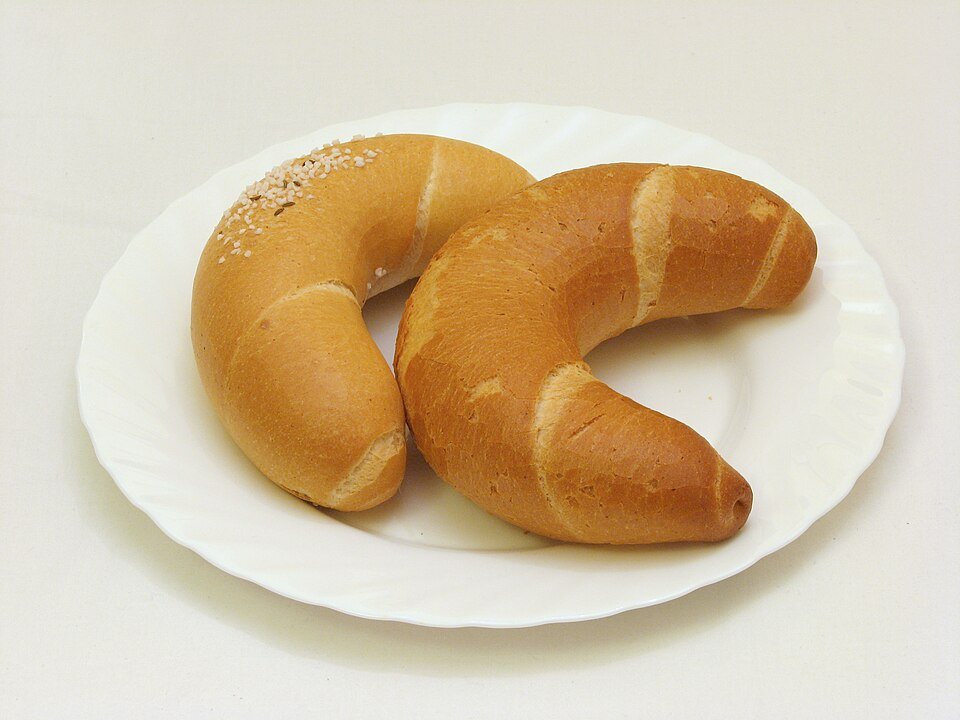
This bakery, which served Viennese specialties including the kipferl and the Vienna loaf, quickly became popular and inspired French imitators (and the concept, if not the term, of viennoiserie). The French version of the kipferl was named for its crescent (croissant) shape and has become a universally identifiable shape across the world. The earliest known recipe for the present-day croissant appears in 1905, although the name croissant appears among the "fantasy or luxury breads" in 1853. Earlier recipes for non-laminated croissants can be found in the 19th century and at least one reference to croissants as an established French bread appeared as early as 1850. Zang himself returned to Austria in 1848 to become a press magnate, but the bakery remained popular for some time afterwards, and was mentioned in several works of the time: "This same M. Zank ...founded around 1830, in Paris, the famous Boulangerie viennoise". Several sources praise this bakery's products: "Paris is of exquisite delicacy; and, in particular, the succulent products of the Boulangerie Viennoise"; "which seemed to us as fine as if it came from the Viennese bakery on the rue de Richelieu". By 1869, the croissant was well established enough to be mentioned as a breakfast staple, and in 1872, Charles Dickens wrote (in his periodical All the Year Round) of "the workman's pain de ménage and the soldier's pain de munition, to the dainty croissant on the boudoir table". The viennoiserie technique that now characterizes the croissant was already mentioned in the late 17th century, when La Varenne's Le Cuisinier françois gave a recipe for it in the 1680 – and possibly earlier – edition. It was typically used not on its own but for shells holding other ingredients (as in a vol-au-vent). It does not appear to be mentioned in relation to the croissant until the 20th century. The first recipe corresponding to the modern croissant, not only for the shape but also the texture of the dough and the taste, was published in 1906, in Paris, in Colombié's Nouvelle Encyclopédie culinaire.[20] Sylvain Claudius Goy was a French chef who is sometimes said to have recorded the earliest recipe of the modern croissant. His 1915 book La Cuisine Anglo-Americaine contains a croissant recipe which Frey Fine Books consider to be the first such recipe published, and they describe the recipe as having "[given] birth to the croissant of present day". Goy's recipe uses a laminated yeast dough known in French as pâte feuilletée levée.
Take a look at the croissant Get in contact with a manufacturer of croissant Back to main page